By Julie and Robert Jensen
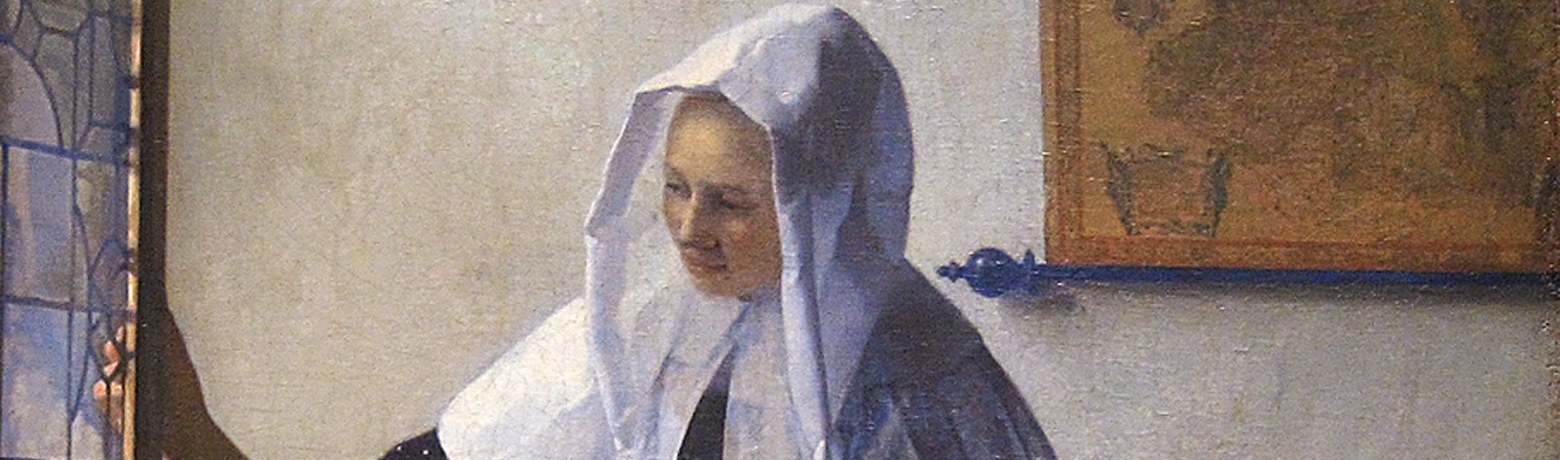
Aesthetic Realism shows that the questions of marriage are aesthetic questions, answered in art. As we look at Vermeer’s Young Woman with a Water Pitcher we will be showing how, through this principle of Aesthetic Realism, stated by Eli Siegel: “All beauty is a making one of opposites, and the making one of opposites is what we are going after in ourselves.”
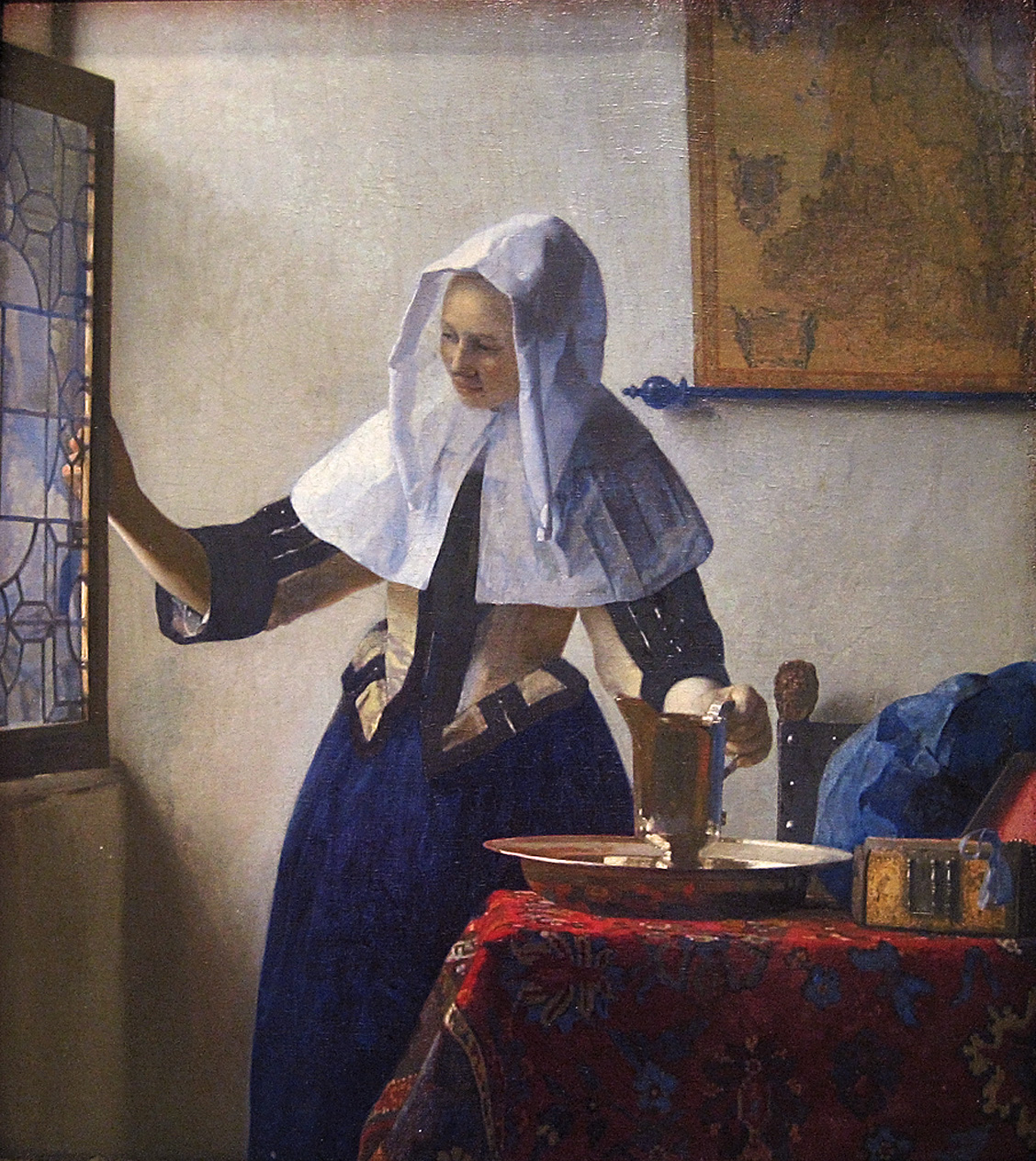
Opposites which once caused so much trouble in our marriage and which pain couples everywhere, are the domestic and the wide. Vermeer’s painting is a beautiful relation of these opposites, of inside and outside, the confined and the spacious. This work painted by Jan Vermeer about 1658 in Holland, and now in the Metropolitan Museum of Art, is only 16 by 18 inches, but study of it opened up vistas for us in our marriage.
Though we felt we needed each other, we also resented each other, because too much we used our care for each other to put the rest of the world aside. In his 1964 lecture, The Furious Aesthetics of Marriage, Eli Siegel explains:
To marry a person has been, in the history of love and marriage, the finding of a shelter against the world as unpleasant….Love, in other words, can be a means of shelter from a unkind world,…or it can be a means of intensifying, affirming, extending, subtilizing a care for the world.
Vermeer’s purpose, as he looked at this woman, was to use her as a means of “intensifying, affirming, extending, subtilizing a care for the world.”
1. The Purpose of Art and Marriage
In an Aesthetic Realism consultation in 1974 we learned how the purpose of art and the purpose of marriage are the same. Our consultants opened a book of reproductions, and showed us this painting. They asked: “What do you see that adds to this woman in a pretty dramatic way?” And they explained:
The big thing in Vermeer is the light. Because she’s in relation to the window it makes her more. She’s bridging the gap between the domestic and the wide world that people have such a hard time doing. She joins things inside and outside.
“What is that on the wall?” I, Julie, asked—and then said, “It’s a map! It’s beautiful!” “Why?,” they asked. I said, “It represents the world.”
Consultants: It’s the outside world, inside. If you took away the map, and the pitcher, and the table, and the window, she’s still a lovely figure, but she’s less. Do you think you have to have the same principle in how you see yourselves, and each other?
Julie Jensen: Yes.
Since this consultation took place we have learned a great deal more, and we continue to learn as we study in classes taught by the Aesthetic Realism Chair of Education, Ellen Reiss. In the 13 years we were married before we met Aesthetic Realism, I, Julie, stayed inside the house most of the time. I would think of Robert being out, working with other people, and I felt jealous. Meanwhile, when he came home, he wanted to go into a shell and not talk to anyone. The main thing we felt at home was dullness, punctuated by arguments and long silences.
And yet we had a whole other life together. We took car trips to Williamsburg, Jamestown, Plymouth Rock, and more than once drove all the way to Washington, DC from our home in New Jersey, for a hamburger, and back again the same night. We would energetically point out the trees, the hills, the sunsets to each other, and we loved to learn about American history. We didn’t know that we were trying to put opposites together. We were snug in our car together and having adventures.
These trips kept our marriage together, but without our Aesthetic Realism education, we would never have felt what we do now, that our home is a beginning point for being fair to the whole world, and the person we married represents that world. Instead, our marriage had two directions, and they fought with each other—we went out towards the world and then retreated into ourselves. If this sounds familiar to you, Vermeer’s young woman answers this question of your life.
Look at the way she reaches out, opening the window, and at the same time her body is gracefully inclined towards the pitcher she is holding. She joins “things inside and outside.” She doesn’t play off one direction against the other. She is making a thoughtful junction of the two, and she is beautiful.
The 17th century Dutch painters are noted for seascapes and landscapes, and interiors. In a great lecture Eli Siegel gave, Aesthetic Realism and Vermeer, he said:
Holland was a great sea-faring country….There was a feeling of great shipping….And also there was the dealing with houses; the Dutch houses are famous: the snugness of their interiors, the cleanness of the houses. And it is this spaciousness and interior quality which is the beginning of Vermeer.
2. Spacious and Snug
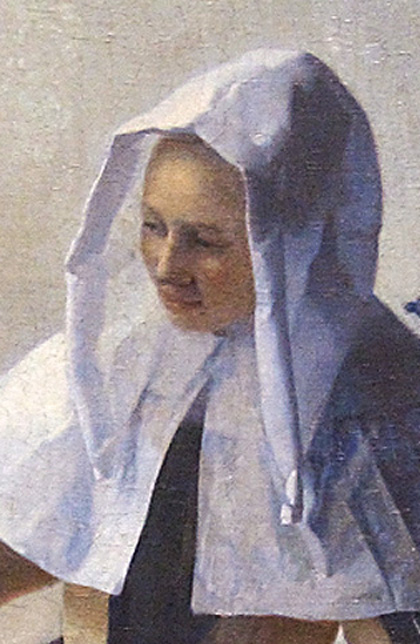
Vermeer puts together these opposites in a way no other Dutch painter did. Look, for example, at the woman’s headdress. It shelters her, but it has within it the white, blue, and faint pink of the open sky.
This is one way Vermeer has us feel that her thoughts, while interior and to herself, are wide and friendly to the world outside.
When a wife is alone in her home, brooding, as I, Julie Jensen, often did, she should ask herself, “Do I want to know the world outside? Do I want to see meaning in the objects around me? Is the reason I feel so trapped in myself because I have not been interested in being fair to what is outside of me?”
We were astonished to learn that the way we saw the objects in our home had to do with why we were angry and bored with each other.
I, Robert, thought once I had a thing I didn’t have to think about it any longer. This was part of my attitude to the world, including my wife. I thought because I had her, I knew her. This is not an uncommon attitude in men, and all wives resent it.
I, Julie, thought that the things we had in our home were mine, and should not be touched or moved by anyone, except me. My husband was only allowed to use one ashtray and sit in one chair. He got so angry one day he yelled, “What is this place—a museum?” I stood guard over the objects in my home, but I didn’t respect them. Vermeer places the objects in his painting ever so carefully, but his purpose is to show that through their relation to each other and to the woman, each is more.
3. Inside and Outside

We learned that there are only two ways of seeing, either with respect or contempt. When people use owning things to feel they do not have to know them, this is contempt. We needed to see that the objects in our home don’t only belong to us, they belong to the whole world.
They have universal qualities which Aesthetic Realism shows unifies all reality—the opposites: hardness and softness, straight line and curve, inside and outside. And this is true of people too, however close to us they may be.
The way Vermeer paints the woman’s hand on the window, both inside and outside are important.
The sun shining on her fingers is continuous with the light on the window frame and the line of light on her arm. The way this woman’s hands are both strong and gentle as she holds these objects shows respect. She is not grabbing them possessively. We feel she is thoughtful of them. There is another drama of inside and outside as the light goes within her sleeve, which is dark on the outside. One expects the inside of something to be dark, and the outside to be light. Light and dark have changed places.
As we have studied the constant relation of inside and outside in this painting, it has helped us to feel that inside and outside are one in the world and need not fight.
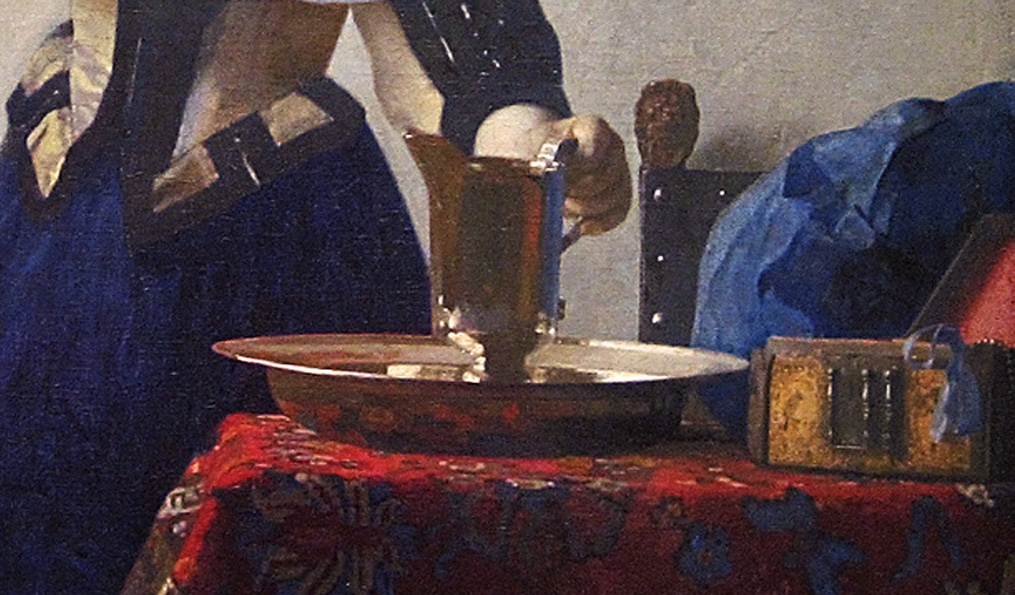
The pitcher and basin are both expansive and narrow—and what is outside is also inside—the basin reflects and has within it the red, yellow and blue pattern of the oriental tapestry, which stands for the rich wide world. The light goes inside the basin, and Vermeer shows it is so inviting and rich. This is the way we have come to be able to feel about what goes on inside each other’s minds.
Marriages will be kind when husbands and wives feel they are part of everything, not just in a little world of their own. You feel Vermeer’s young woman is married to everything, through that light; and you feel she is strong and kind.
In his lecture Aesthetic Realism and Vermeer, Eli Siegel describes Vermeer’s work with exactness, justice and depth. He said:
Vermeer has a rich, billowy, and neat color with a precise surface. He is saying that this thing may be restricted because its so precise, but look at its gladness, its depth, its billow also. Vermeer likes to take a room and give it this neat gold, or this neat light….When Vermeer says, Here is a person who can be gentle and golden and neat, he is saying, “My brethren, you have not seen the world as well as you might, and I have a message through this light.”
We are glad to tell people how the study of Aesthetic Realism can add new meaning to marriage.
Julie and Robert Jensen studied in classes with Eli Siegel, and in professional classes for consultants and associates taught by Aesthetic Realism Chair of Education, Ellen Reiss. Julie Jensen (1939 – 2014) was an Aesthetic Realism consultant. She authored many scholarly articles and gave talks on what she learned from Aesthetic Realism.